Brown Hawk-Owl (Ninox scutulata), St. Paul Island, Alaska: August 27 - September 3, 2007
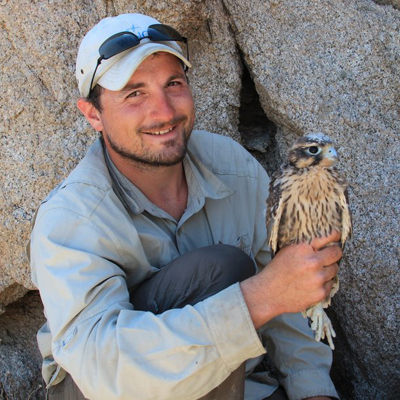
August 27th was a big day for one of our Senior Guides, Jake Mohlmann. While guiding on St. Paul Island (for Saint Paul Island Tours - www.alaskabirding.com), he turned up a first North American record! Below are some of the photos he has provided, as well as the exciting story of how he found this special bird.

Here the little guy is peeking out from inside a crab pot, presumably the only shelter which vaguely resembled the forested habitat of its native south Asia. (Photo by Jake Mohlmann)
Ever wonder what it's like to find a bird never before seen in North America? In Jake's words:
At 4:30PM I arrived at the northernmost set of crab pots
next to the salt lagoon. My usual method for birding this area is to
systematically walk up and down each row of pots waiting for something to flush
or call. Most of the time the sole inhabitant of the pots are the local
Gray-crowned Rosy-Finches. Today there was a higher number than usual, so I sat
for a while and duplicated their calls with some scattered pishing to get them
interested in my whereabouts. When no other birds showed up I ventured to the
other stack of pots closest to the gas station. Again, up and down each row,
calling and pishing. When I was squeezing through some closely situated rows or
pots, a
large bird flushed about 5 feet from my head, flew away down the corridor, and alighted
on a piece of trash at the end.
As the bird took off I noticed a flight which closely
resembled an accipiter...2 quick flaps and a glide on slightly arched
wings. When it swooped to perch, it spread its wings and tail wide,
which also gave me the impression of a young accipiter. The tail and wings were
brown with darker barring running the length of the wings and through the width
of the tail. I was fully anticipating some weird Eurasian accipiter until it
perched, turned and looked at me with it's HUGE intimidating yellow eyes. Now
this bird was looking more like an owl. The eyes were positioned closely
together on the front of its head and appeared very wary, looking around at
where to fly next. This bird resembled an owl at this point, however it was
lacking two features I would usually associate with an owl of its size to be expected
in this region. It had no clearly evident 'ears' and didn't appear to have any
visible facial disk. The coloration was solid chocolate brown throughout the
entire head and back region. Its chest and belly were a pale cream color with chocolatey streaks throughout.
The first words out of my mouth were "OH S*#T". This phrase
was repeated over and over as I ran back to the van to get the camera in hopes
it hadn't taken off. Upon arriving back at the location the bird was missing, so
I started hopping from row to row cautiously peering around corners to get
another glimpse of this (at this point) mystery bird. By now the ever so abundant breeding rosy-finches helped me out big
time. Several of them had
noticed this odd visitor swooping in and out of their crab pots and decided
instinctively to
scold and mob it. I followed the sound and lo and
behold, the owl was sitting 10 feet under two very agitated adult rosy-finches
trying its hardest to blend in with the rusty crab pots. I was able to grab a
couple quick photos (these are the blurry ones found below) and quickly jumped in the van to go alert the tour group that was
on the island.
I'm glad the local police didn't have a speed trap set up on
the road to the southwestern portion of the island this day. Although extremely
beat up, rattley, and seemingly shockless, the St. Paul tour vans handle quite well! A
short 5 (usually 10) minute drive to Zapadni beach produced the tour guide on
duty, Dylan, and the rest of the tour group on the island. I pulled up next to
him and said "can you say MEGA?. I don't know what this bird is but it looked
like a cross between an accipiter and an owl. I've never seen this in any field
guides!" He rallied the troops and we all made it back to the crab pots around
5:00PM. We were able to obtain more pictures before the bird was flushed up and
over Black Diamond Hill.
In the evening at 10:00PM the fish & wildlife representatives
on the island and tour guides tried to relocate the bird and were successful. It
decided to roost in a spot near where it was originally located.
Just another day of birding on St. Paul Island...
Email me if you have any questions about this bird. Pretty exciting bird!
Cheers,
Jake Mohlmann
mohlmann2@yahoo.com
Here are a few of the first pictures taken:
(photos by Jake Mohlmann)

As seen from behind, with just a hint of those big yellow eyes visible.

Just at takeoff, the dark barring on the tail is visible.

Barring visible in the flight feathers both above and below the wings.

Interesting image showing the rather un-owlish flight posture.
Congratulations again to Jake on this great find!!
Brown Hawk-Owl refound Sept 1, 2007
A brief update on "the highlight of this season, and any other season on Saint Paul this side of the millennium," (as a veteran St. Paul guide put it):
Rich Hoyer was successful in relocating the Brown Hawk-Owl on September 1st, still hanging around the crab pots. On the 3rd, the bird was thoroughly enjoyed by a lucky group of birders from Gambell Island. They chartered a plane just to see it, which turned out to be a good idea...the bird has not been seen since then!
Photo courtesy of Rich Hoyer
It should be noted that some consider this subspecies of Brown Hawk-Owl to be a separate species, known as Northern Boobook (Ninox japonica). A 2002 paper by Ben King supports this split:
King, B. 2002. Species limits in the Brown Boobook (Ninox sculata) complex.
Bull. British Ornithol. Club
122(4):250-258.
or